Bank payment obligation is a new payment method in international trade. Main payment methods in international trade so far were cash in advance payment, documentary collections, documentary credits and open account.
For example, open account and cash in advance payments are elementary payment options. They are not only simple, but also inexpensive. However they inherit high volumes of risks either for the importers or the exporters.
Documentary credits, on the other hand, are relatively secure payment methods, but they are complicated and expensive.
Does international trade finance need another payment method? Can bank payment obligation be the right answer?
Definition of Bank Payment Obligation:
Bank payment obligation (BPO) is an irrevocable undertaking given by an Obligor Bank (typically buyer’s bank) to a Recipient Bank (usually seller’s bank) to pay a specified amount on a agreed date under the condition of successful electronic matching of data according to an industry-wide set of rules adopted by ICC.
Some Important Definitions under Bank Payment Obligation (BPO):
- “Obligor bank” means buyer’s bank under Bank Payment Obligations. Obligor bank issues the legally binding, valid, irrevocable but conditional and enforceable payment undertaking to Recipient Bank. Obligor bank is an equivalent term of issuing bank under letters of credit definitions.
- “Recipient Bank” means seller’s bank under Bank Payment Obligations.
- “Trade Services Utility” (TSU) means a centralized matching and workflow engine providing timely and accurate comparison of data taken from underlying corporate purchase agreements and related documents, such as commercial invoices, transport and insurance.
- The URBPO, the Uniform Rules for Bank Payment Obligations ICC publication No. 750, are the rules of Bank Payment Obligation adopted by ICC banking commission.
How Does Bank Payment Obligation Work?
Bank payment obligation and letter of credit have some characteristics in common.
Firstly banks play a key role on both payment methods. Secondly banks are giving the irrevocable payment undertaking.
Figure 1 : Basic Bank Payment Obligation Transaction
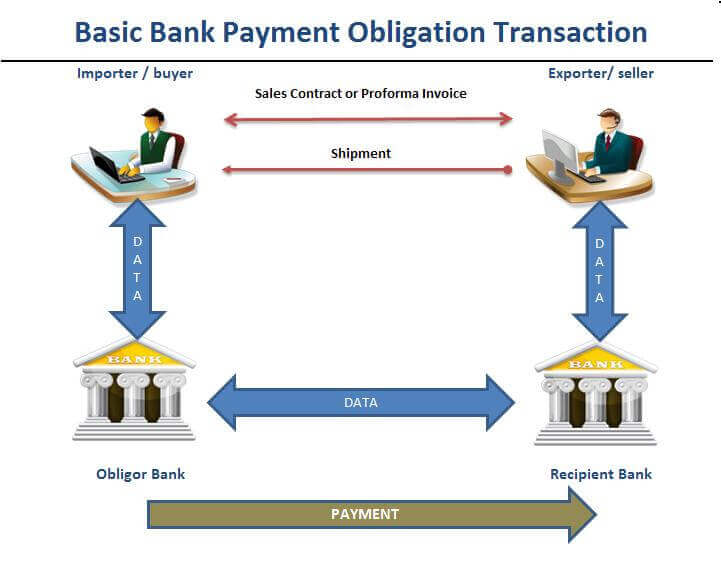 Bank Payment Obligation (BPO) has been established on two main expectations,
- The use of minimum fields, the buyer, the seller and respective banks agree on the payment terms and conditions and on the minimum trade information required to assess the credit risk;
- The dispatch of documents, such as the bill of lading, certificate of origin and certificate of quality, from the seller directly to the buyer.
Given the limited information required by the banks and the accelerated document exchange, companies should expect a lower rate of discrepancies and an acceleration of the settlement process.
Figure 2 : Bank Payment Obligation Transaction Flow in Detail
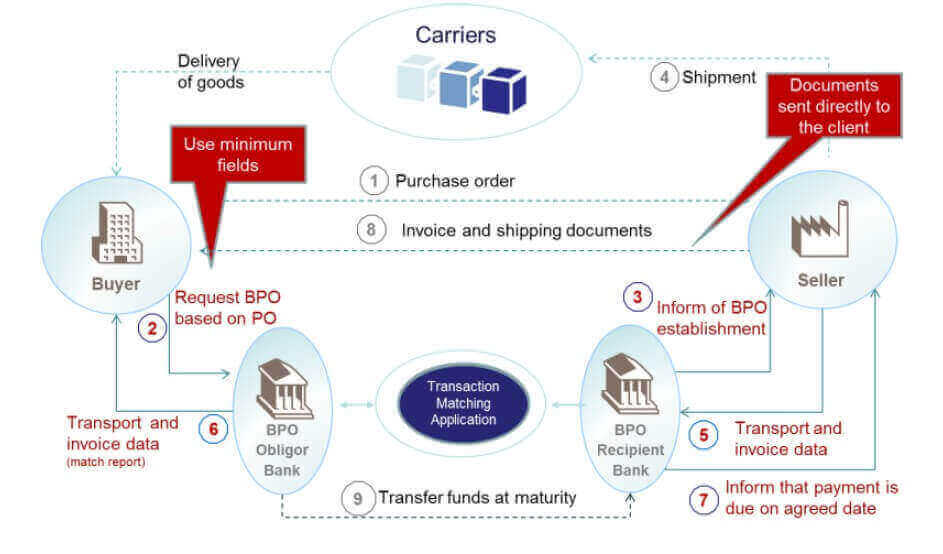
Step-by Step Bank Payment Obligation Transaction
Baseline Establishment
- Step 1 : Buyer and seller agreed on BPO (bank payment obligation) as a payment term on the sales contract. Buyer send its purchase order to the seller.
- Step 2 : Buyer provides the minimum data from the purchase order and conditions of the bank payment obligation to the obligor bank.
- Step 3 : Seller confirms the data from the PO and send its acceptance of the BPO conditions to the recipient bank. If both buyer’s and seller’s data are matched on the Transaction Matching Application than the baseline is established. Both buyer and seller will be receiving a matching reports from their banks.
BPO is irrevocable but conditional payment method. (payment is subject to the electronic matching of agreed data-sets)
Matching
- Step 4 : Seller ships the goods as agreed on the sales contract.
- Step 5 :Seller presents the shipment data and invoice data to its bank, which submits it to Transaction Matching Application for matching.
- Step 6 : Buyer receives a match report from its bank. Buyer is invited to accept any mismatches if any.
- Step 7 : Seller’s bank inform seller about the successful data-set match.
BPO becomes operative and due according to the agreed payment terms.
Settlement
- Step 8 : Seller sends the trade documents directly to the buyer. Buyer will clear goods from the customs with these documents.
- Step 9 : On the due date, the obligor bank debits the proceeds from buyer’s account
BPO is irrevocable but conditional payment method. (payment is subject to the electronic matching of agreed data-sets)
BPO becomes operative and due according to the agreed payment terms.


Tidak ada komentar:
Posting Komentar